
Common Dealership Appraisal Tactics: 2026 Seller's Guide
Discover common dealership appraisal tactics in our 2026 Seller's Guide. Learn strategies to understand trade-in values and negotiate better deals.
Common Dealership Appraisal Tactics: 2026 Seller’s Guide

Common dealership appraisal tactics are specific strategies dealers use to assess, price, and negotiate trade-in offers while protecting their profit margins. The industry term for this process is vehicle trade-in appraisal, and it follows a structured method that factors in wholesale pricing, reconditioning costs, and market comparables. Most appraisals take 15–30 minutes, but the pricing decisions behind them reflect hours of dealer math. Understanding how that math works puts you in a far stronger position at the negotiating table.
1. How do dealerships determine trade-in values?
Dealers base trade-in offers on wholesale value, not retail price. Consumers often confuse retail values with trade-in values, which are wholesale-based and consistently lower. That gap exists because the dealer must resell your car at a profit after covering all costs between purchase and sale.
The core factors dealers evaluate include:
- Mileage: High mileage reduces resale appeal and increases mechanical risk.
- Condition: Paint, interior wear, tire depth, and mechanical soundness all affect the score.
- Accident history: A clean Carfax report holds more value than a flagged one.
- Market demand: A truck sells faster in Alberta than a two-door coupe, and dealers price accordingly.
- Reconditioning costs: Reconditioning is the largest variable in appraisal pricing, often costing $800 to $1,500 per vehicle.
Accurate appraisal requires standardized evaluation criteria across mileage, condition, accident history, and market comparables. Top dealers use rubrics to reduce appraisal errors and protect margin. That standardization works in their favor, not yours, unless you know what criteria they are scoring.
Dealer acquisition costs for auction-sourced vehicles range from $1,250 to $2,300, including fees and reconditioning. Dealers apply similar cost logic to trade-ins. Every dollar they spend getting your car retail-ready comes off your offer.

2. Common dealership appraisal tactics used to protect profit margins
Dealers use a consistent set of appraisal techniques to control the deal structure and maximize their margin. Knowing these tactics by name removes their power.
- Bundling the trade-in with the new vehicle price. Dealers often negotiate both at the same time, which lets them give with one hand and take with the other. You might get $500 more on your trade-in while losing $700 on the purchase price.
- Inflated reconditioning estimates. A dealer may quote $1,200 in reconditioning costs for minor scratches and a tire rotation. That estimate directly reduces your offer, and you rarely see the actual repair invoice.
- The “leg” tactic. This involves quoting monthly payments instead of total price. Dealers use emotional tactics and jargon like “floor plan assistance” to confuse buyers and justify higher prices. Monthly payment framing hides how much you are actually losing on the trade-in.
- Artificial urgency. “This offer is only good today” is a pressure tactic, not a policy. Dealers use time pressure to prevent you from getting competing offers.
- Separating the appraisal from the purchase. Some dealers appraise your car before you have agreed on a new vehicle price. This locks in a low trade-in number before you have any leverage.
Pro Tip: Always negotiate the new vehicle price to your satisfaction before you reveal you have a trade-in. Separating these conversations protects both sides of the deal.
3. How can car owners identify red flags in the appraisal process?
Red flags in a dealership appraisal are usually visible if you know what to watch for. The most common sign of a lowball offer is a vague or undocumented condition assessment. If the appraiser cannot show you a written scoring sheet, the number is subjective and negotiable.
Here are the most reliable warning signs and counter-moves:
- The offer arrives with no explanation. A fair appraisal comes with a breakdown. Ask for the condition score and the market comps they used.
- The reconditioning estimate is verbal only. Demand a written estimate. Verbal numbers are placeholders designed to shrink your offer.
- They focus on monthly payments, not total price. Redirect every conversation to the total cash value of the trade-in.
- The offer drops after you mention a new car. This is the bundling tactic in action. Keep negotiations separate.
- They rush the walkthrough. Collaborative vehicle walkthroughs during appraisal build trust and reduce negotiation friction. A rushed walkthrough skips that trust-building and leaves room for arbitrary deductions.
Pro Tip: Get a written offer from an online car buyer before you walk into any dealership. Multiple firm written offers can increase the dealership trade-in offer by up to $3,500.
Willingness to walk away is a strong negotiation tool that often improves dealer offers. Dealers know a walk-away loses the sale entirely. That knowledge gives you real leverage if you use it calmly and credibly.
Always verify the final trade-in value in writing before you sign any contract. Numbers discussed verbally during negotiation sometimes shift between the conversation and the finance office.
4. Dealership appraisal process versus independent appraisals and online offers
The difference between a dealer appraisal and an independent cash offer comes down to who bears the cost of resale. Dealers price your car to cover overhead, reconditioning, lot time, and profit. An independent buyer or online car-buying service prices your car closer to its actual market value because their cost structure is leaner.
| Appraisal type | Basis of offer | Firmness | Best use |
|---|---|---|---|
| Dealership trade-in | Wholesale minus reconditioning and overhead | Negotiable | Convenient if bundled with a new car purchase |
| Independent cash offer | Market value with lower overhead | Usually firm | Strongest as a competing offer at a dealership |
| Online car-buying service | Algorithm-based market data | Firm within inspection | Ideal for fast, hassle-free sales |
Independent and online offers are firm, which makes them powerful bargaining chips. Separating trade-in negotiation from new vehicle pricing and focusing on cash total rather than payment terms uncovers true offer value and prevents dealer bundling tactics. Walking in with a written independent offer forces the dealer to beat it or lose the trade-in entirely.
The main disadvantage of independent appraisals is logistics. You need to arrange the sale separately from your new car purchase. For sellers who are not buying a replacement vehicle, that is not a disadvantage at all. For sellers who want to compare selling methods before committing, independent offers provide a clear market benchmark.
Separating trade-in negotiation from new vehicle price can increase the trade-in offer by $1,200 to $3,500. That range represents real money, and it comes entirely from structuring the conversation differently.
Key takeaways
Dealership appraisal tactics follow a predictable pattern, and sellers who separate trade-in negotiations from purchase price discussions consistently receive higher offers.
| Point | Details |
|---|---|
| Wholesale pricing drives offers | Dealer trade-in values are based on wholesale cost, not retail price, so expect a gap. |
| Reconditioning costs reduce your offer | Dealers deduct $800–$1,500 in reconditioning estimates, so get those figures in writing. |
| Bundling hides true value | Negotiate new car price before revealing your trade-in to prevent bundled manipulation. |
| Written competing offers add leverage | A firm independent offer can push a dealer’s trade-in number up by $1,200–$3,500. |
| Walk-away power is real | Dealers lose the full sale if you leave, so willingness to walk away improves your position. |
What I have learned about dealership appraisals after years in the car market
The single biggest mistake sellers make is treating the trade-in appraisal as a fixed number. It is not. Every element of a dealer appraisal is a negotiating position, not a final answer.
I have seen sellers walk in with nothing but hope and walk out with $1,500 less than their car was worth. I have also seen sellers walk in with two written competing offers, a clean Carfax report, and a clear sense of their car’s fair market value and walk out with a number that surprised even the dealer.
The preparation gap between those two sellers was about 45 minutes of research. That is the real cost of not understanding how the appraisal process works.
One thing most articles get wrong: they tell you to “do your research” without specifying what research actually moves the needle. The answer is firm written offers from independent buyers. Not Kelley Blue Book estimates, not online calculators. Actual written offers that a dealer can see and respond to. That is the only number that creates real pressure.
Focus on total deal value, not monthly payments. A dealer who drops your payment by $30 a month while cutting your trade-in offer by $1,800 has not done you a favor. Run the math on the full transaction every time.
— Omar
Selling your car without the negotiation stress
If the appraisal process feels like a game you did not sign up to play, there is a direct alternative. Sellkamocars provides instant cash offers based on current market data, with no haggling, no bundled pricing tactics, and no waiting.
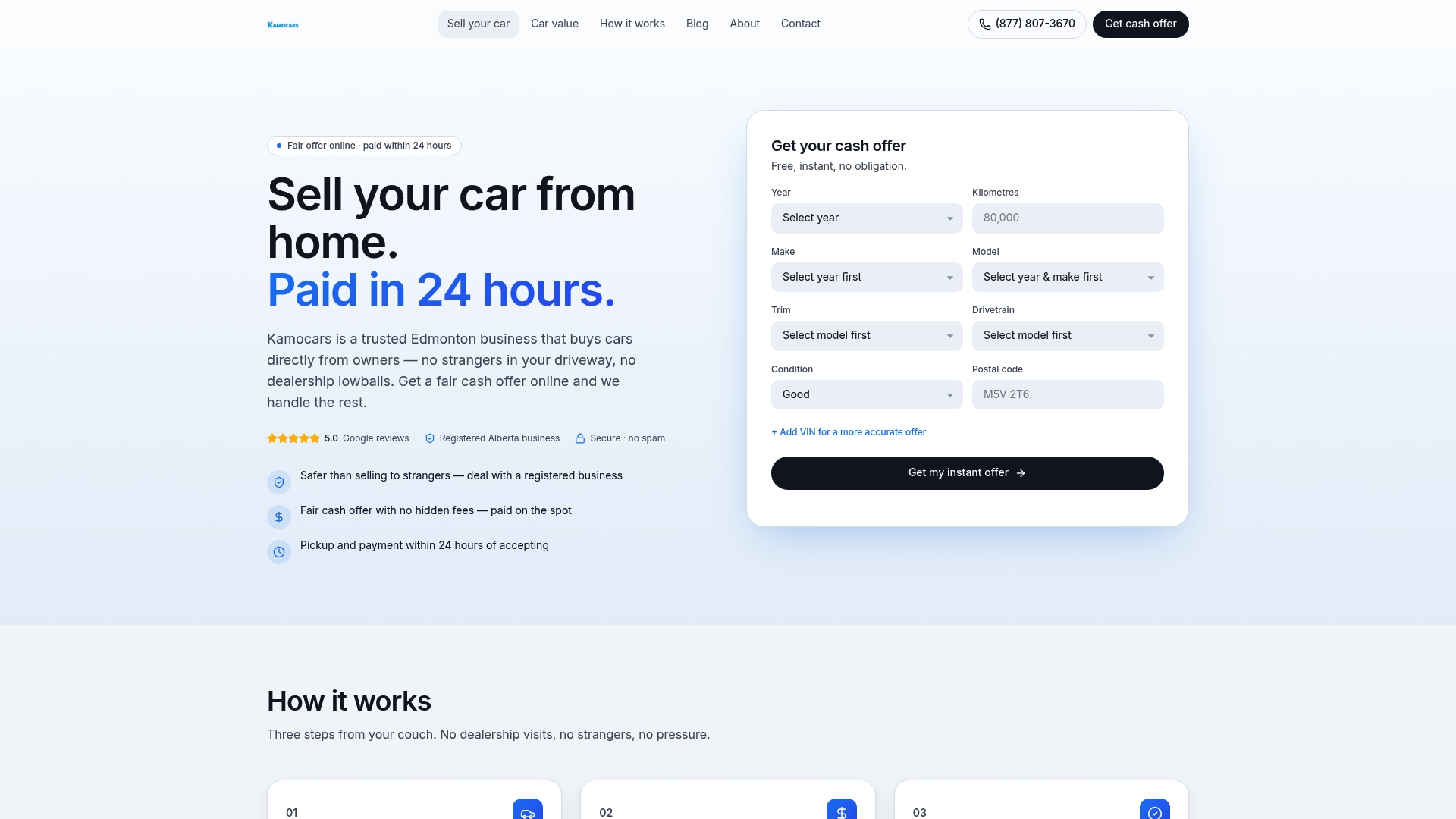
Sellkamocars handles pickup and payment within 24 hours, and the offer you receive is the amount you get paid. With over 500 completed transactions and a registered business status that protects sellers, the process is built for people who want a fair number fast. See how it works and get your offer without stepping into a dealership. If you are in the Edmonton area, Sellkamocars also offers a dedicated sell your car in Edmonton service with same-day response.
FAQ
What are the most common dealership appraisal tactics?
The most common tactics include bundling the trade-in with new vehicle pricing, using inflated reconditioning estimates to lower offers, and quoting monthly payments instead of total cash value. Dealers also use artificial urgency to prevent sellers from gathering competing offers.
How does the dealer appraisal process work?
A dealer appraises your vehicle by scoring its mileage, condition, accident history, and local market demand, then subtracts estimated reconditioning costs and overhead to arrive at a wholesale-based offer. The process typically takes 15–30 minutes but reflects a detailed cost calculation.
How do independent appraisals differ from dealer appraisals?
Independent and online appraisals carry lower overhead than dealership offers, so they typically come in closer to actual market value. They are also firm offers, which makes them effective leverage when negotiating with a dealer.
How can I negotiate a better trade-in offer?
Negotiate the new car price before disclosing your trade-in, bring written competing offers from independent buyers, and always ask for the condition scoring sheet. Structured negotiation can increase your trade-in offer by $1,200 to $3,500 compared to accepting the first number.
What is a red flag in a dealership appraisal?
A verbal-only reconditioning estimate, a rushed vehicle walkthrough, or an offer that arrives with no written breakdown are all red flags. Any dealer who shifts the conversation to monthly payments instead of total trade-in value is using a tactic designed to obscure the real number.
Recommended
Get a real cash offer in 2 minutes
Trusted business. Fair price. Paid on the spot when we pick up your car.