
Vehicle Book Value Explained for Buyers and Sellers
Discover how vehicle book value impacts your buying or selling experience. Learn its significance for fair negotiations and better decisions.
Vehicle Book Value Explained for Buyers and Sellers

Vehicle book value is a standardized estimate of what your specific car, truck, or SUV is worth right now, based on data rather than opinion. It matters because lenders, insurers, and dealers all lean on this number as their starting point: banks use it to set financing limits, insurers use it to calculate payouts on totaled vehicles, and dealers use it to build their offers. New vehicles lose roughly 16% of their value in the first year alone, which is why book value shifts constantly and why a number pulled from Canadian Black Book six months ago may already be stale.
Here’s the practical part. If you’re selling a 2021 truck, financing a used SUV, or fighting an insurance settlement after an accident, book value tells you where the negotiation should start, not necessarily where it should end. Understanding the gap between that baseline number and what a buyer will actually pay is where sellers either leave money on the table or walk away with a fair deal. Sellkamocars builds its own cash offers starting from this same baseline data before adjusting for condition and local demand, which is a good preview of how the whole system works.
Key Takeaways
Vehicle book value is a data-driven baseline estimate, not a fixed price, and using it well means checking multiple sources, documenting your car’s history, and expecting professional cash offers to land below private-party figures.
| Point | Details |
|---|---|
| Book value is a range, not one number | Wholesale, trade-in, private-party, and retail figures all sit at different points on the same scale. |
| First-year depreciation hits hardest | New vehicles can lose roughly 16% of their value in year one alone, so timing matters. |
| Check multiple valuation tools | Canadian Black Book, J.D. Power, and CarGurus use different data and rarely agree exactly. |
| Documentation moves your number | Service records and clean history reports push condition scores and offers higher. |
| Cash offers price in reconditioning | Expect fast-buy offers to sit below private-party estimates to cover inspection and resale risk. |
Table of Contents
- What Vehicle Book Value Actually Measures
- The Factors That Actually Move Your Book Value
- Which Valuation Tool Should You Actually Trust?
- Book Value vs. Market Value vs. Trade-In: What’s the Real Difference?
- How to Estimate Your Car’s Book Value Yourself
- How Lenders and Insurers Actually Use This Number
- Using Book Value When You’re Buying or Selling
- How a Fast Cash Offer Actually Gets Built From Book Value
- How Often Does Book Value Change, and Why?
- Why Depreciation Schedules Drive Most of the Calculation
- Where Book Value Falls Short
- Why We Built This Explanation Around Steps, Not Theory
- Frequently Asked Questions
- Sources
What Vehicle Book Value Actually Measures
Book value isn’t one number. It’s an estimate built from aggregated data points: your vehicle’s model year, trim level, mileage, mechanical condition, factory options, and how similar vehicles are selling in your region. Valuation providers feed this information through an algorithm and spit out a range rather than a single figure, because a range reflects reality better than false precision ever could.
That range typically breaks down into four tiers, from lowest to highest:
- Wholesale/auction value – what dealers pay each other at auction, the floor of the range.
- Trade-in value – what a dealership offers when you trade toward another purchase.
- Private-party value – what you’d reasonably expect selling directly to another consumer.
- Dealer retail value – the sticker price you’d see on a dealer’s lot after reconditioning and markup.
Here’s a rough example. A 2022 Honda CR-V EX-L with average mileage and no accident history might show a wholesale figure near $24,500, a trade-in value around $26,000, a private-party estimate near $28,500, and a dealer retail price closer to $31,000. Same car, four different numbers, each one built for a different transaction. The 16% first-year depreciation hit is baked into all four figures, which is why a nearly-new vehicle’s book value can feel surprisingly low compared to what you paid at the dealership.
The Factors That Actually Move Your Book Value
Every valuation tool weighs the same core inputs, just with slightly different formulas. Knowing which levers matter most helps you understand why your neighbor’s identical truck might be valued $3,000 higher or lower than yours.
- Model year and age drive the bulk of the calculation, since depreciation schedules apply a residual percentage tied directly to how many years old the vehicle is.
- Mileage gets compared against an expected annual average (usually 16,000 to 20,000 km per year in Canada); running well above that average drags the number down fast.
- Mechanical condition covers everything from tire wear to whether the check-engine light is on, and it’s scored on a scale most tools label as excellent, good, fair, or poor.
- Accident and repair history shows up through vehicle-history reports and can knock thousands off an otherwise clean valuation, even after a proper repair.
- Trim level and factory options matter more than most sellers expect. A base model and a fully loaded trim of the same year can carry a $4,000 to $6,000 spread.
- Documented maintenance doesn’t just support your asking price, it actively raises the condition score some tools apply.
- Regional demand shifts values by province and even by city. Trucks and AWD vehicles tend to hold value better in colder markets, while compact sedans often do better where fuel costs weigh heavier on buyer decisions.
Pro Tip: Before getting any car appraised, spend $150 to $200 on a professional detail and fix small cosmetic issues like cracked windshields or worn wiper blades. These low-cost fixes routinely move a vehicle up a full condition tier, which can add hundreds or even thousands to the final book-based number.
Owners looking at how condition specifically affects dealer offers will notice the same inspection categories show up again and again across every valuation platform.
Which Valuation Tool Should You Actually Trust?
You’ll run into a handful of names repeatedly once you start researching your vehicle’s worth, and each one serves a slightly different purpose.
- Canadian Black Book leans heavily on wholesale and auction data, making it the go-to reference for trade-in and dealer-side pricing across Canada.
- J.D. Power (formerly NADA in the US) blends dealer transaction data with broader market trends, and tends to track closer to retail pricing.
- Carfax Canada doesn’t generate a value on its own but supplies the vehicle-history data (accidents, service records, ownership changes) that other tools use to adjust their estimates up or down.
- CarGurus pulls from live consumer listings rather than dealer wholesale data, which is why it tends to track closer to what buyers are actually paying in the current market.
- Kelley Blue Book and Edmunds, both widely used in the US and referenced by Canadian shoppers researching cross-border pricing trends, ask for year, make, model, trim, mileage, and condition to generate a working range.
Use trade-in figures when you’re negotiating with a dealership or estimating what you’ll owe against a loan. Use private-party figures when selling directly to another consumer or benchmarking a private purchase. Use retail figures only as a ceiling, since that’s the price after a dealer’s reconditioning and margin are added on. No single tool should be your only stop. Since different platforms weigh auction data, retail listings, and regional inputs differently, pulling estimates from two or three sources and averaging them gets you closer to reality than trusting one algorithm alone.
Book Value vs. Market Value vs. Trade-In: What’s the Real Difference?
These terms get used interchangeably by people who should know better, and that confusion costs sellers real money. Book value is a standardized, data-driven estimate that banks and insurers rely on for consistency. Market value is what an actual willing buyer will pay in the open market right now, which can swing daily with local supply, gas prices, or even seasonal demand for trucks versus convertibles.
| Value Type | Primary Use | Typical Position in Price Range | How It’s Calculated |
|---|---|---|---|
| Wholesale/auction | Dealer-to-dealer transactions | Lowest | Auction sale data |
| Trade-in | Dealership trade toward new purchase | Low | Dealer algorithms minus reconditioning costs |
| Book value (baseline) | Loans, insurance, general reference | Middle | Aggregated data: age, trim, mileage, condition |
| Private-party | Direct consumer-to-consumer sale | Upper-middle | Comparable private listings |
| Dealer retail | Vehicle purchased off a dealer lot | Highest | Book value plus reconditioning, marketing, margin |
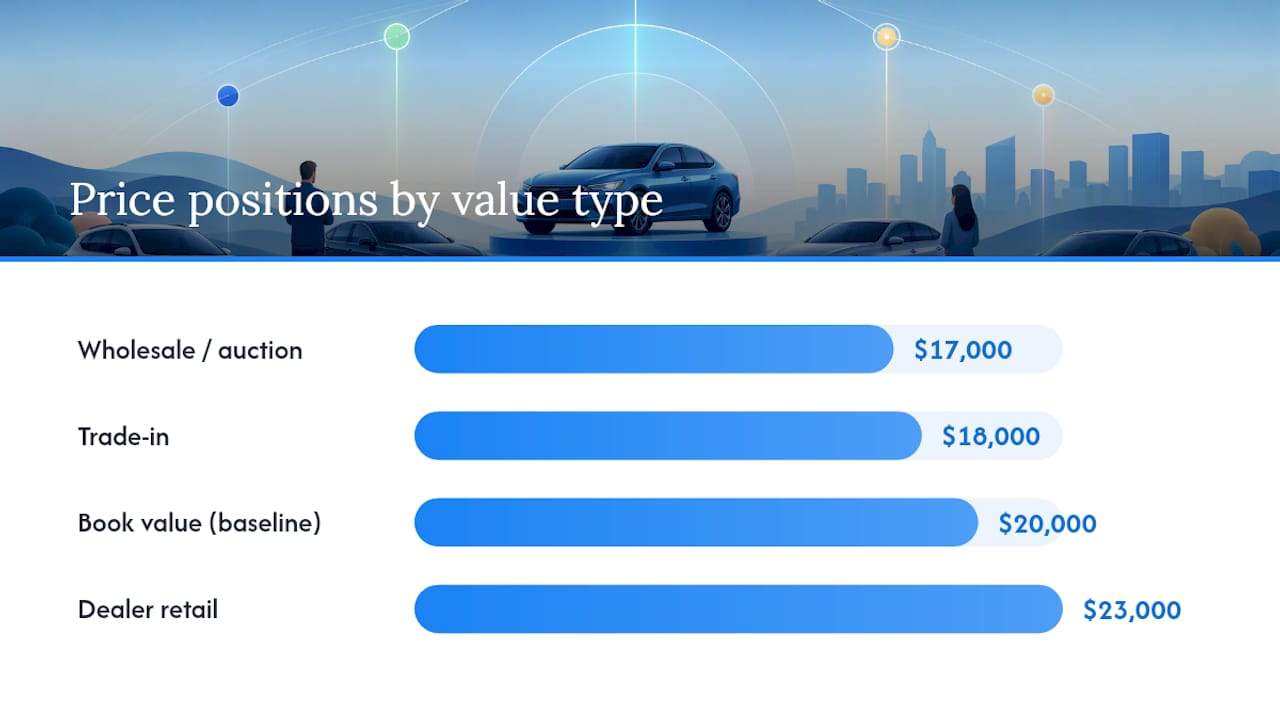
For a $20,000 book-value vehicle, you might realistically see a wholesale figure near $17,000, a trade-in offer around $18,000, and a dealer retail price closer to $23,000 for that same car once it’s been reconditioned and put on a lot. Trade-in numbers sit lower than private-party figures specifically because dealers have to cover reconditioning, marketing, and profit margin before they ever resell the car. Fair market value, a term insurers and appraisers also use, reflects what a typical buyer would pay in a competitive, seasonal market, and it can diverge from book value when local inventory is unusually tight or flooded.
How to Estimate Your Car’s Book Value Yourself
You don’t need a dealership to get a solid number. Follow these steps and you’ll land within a few hundred dollars of what professional appraisers would tell you.
- Pull your VIN and confirm exact trim. Small trim differences (a sport package, a tow package) change value more than most owners expect.
- Check two or three valuation tools. Run your VIN, mileage, and condition through Canadian Black Book, J.D. Power, and CarGurus, and write down each range.
- Pull a vehicle-history report. A Carfax Canada report confirms accident history and ownership count, both of which adjust your number downward if anything shows up.
- Check local listings. Search your city or province for comparable vehicles currently for sale to sanity-check the algorithm’s output against real asking prices.
- Average the ranges and adjust for documentation. If you have complete service records, nudge your estimate toward the higher end of the range; if you’re missing history or have unresolved mechanical issues, lean toward the lower end.
Here’s how that math plays out for a 2020 Toyota RAV4 XLE with 68,000 km:
That $2,700 spread between private-party and trade-in isn’t arbitrary. It’s the dealer’s built-in cost of reconditioning and resale risk, the same gap Canadian Black Book vs. market value data consistently shows across vehicle categories. For a deeper walk-through of how online tools translate these inputs into a real number, see this step-by-step online valuation guide.
How Lenders and Insurers Actually Use This Number
Financing and insurance are where book value stops being an abstract reference and starts affecting your wallet directly. Lenders express financing limits as a percentage of book value, called loan-to-value or LTV, and most won’t finance above 100% or 125% of that figure without requiring a larger down payment or additional collateral.
- Lenders check book value at origination and sometimes again if a loan is refinanced or restructured.
- Insurers use actual cash value, a close cousin of book value, to calculate total-loss payouts after an accident.
- Adjusters frequently land on a lower number than what online tools show, since they factor in regional salvage data and their own internal formulas.
- You can dispute a low insurance offer by submitting comparable local listings, service records, and even an independent appraisal.
- Falling behind on a loan while your vehicle depreciates faster than you’re paying it down creates an upside-down loan situation, where you owe more than the car is worth.
Pro Tip: Keep every maintenance receipt, oil-change record, and repair invoice in one folder from the day you buy the car. When an insurer or lender questions your vehicle’s condition, that documentation is often the difference between accepting their number and successfully pushing back on it.
If a settlement offer still feels wrong after you’ve supplied documentation, request a written explanation of the adjuster’s methodology and consider a paid independent appraisal, particularly on higher-value vehicles where a few thousand dollars is worth the $150 to $300 appraisal fee.
Using Book Value When You’re Buying or Selling
The checklist looks different depending on which side of the transaction you’re on.
If you’re selling:
- Gather your maintenance records, original purchase paperwork, and any warranty documents before you request quotes.
- Run a Carfax Canada report yourself so you can address any red flags before a buyer finds them first.
- Price closer to the private-party figure if you’re selling directly, or expect trade-in-level numbers if you’re going through a dealership.
- Get multiple offers, since comparing quotes side by side routinely surfaces a few hundred to a few thousand dollars of difference between buyers.
If you’re buying:
- Compare the asking price against both retail and private-party book estimates, not just the seller’s number.
- Pull a history report independently rather than trusting the one a private seller provides.
- Factor in any deferred maintenance you’ll need to handle in the first six months of ownership.
- Set a firm walk-away price before you start negotiating, and stick to it.
Negotiation works best when both sides bring printed valuation ranges to the table instead of arguing from memory or gut feeling. A seller who shows up with a Canadian Black Book printout and complete service history has a materially stronger position than one who simply insists their car is “worth more than that.” For sellers weighing private sale against a dealer trade or an instant cash offer, this comparison of selling options breaks down the trade-offs in more detail.
How a Fast Cash Offer Actually Gets Built From Book Value
Professional buyers don’t just read your book value off a screen and hand you a check. The process runs through several layers before a final number appears.
- Automated valuation inputs. Your VIN, mileage, and basic condition answers generate an initial baseline pulled from wholesale and market data.
- Remote inspection questions. You’ll answer specifics about tire condition, warning lights, interior wear, and accident history before anyone sees the car in person.
- Physical inspection. A trained inspector confirms what you reported and checks items that online tools simply can’t see, like frame damage or mismatched paint.
- Reconditioning estimate. Any gap between what you reported and what the inspector finds gets priced out, whether that’s new tires, a windshield chip, or a failed emissions test.
- Final offer. The number that comes out the other end typically sits below private-party value and closer to a strong trade-in figure, because the buyer is pricing in reconditioning costs, resale risk, and wholesale liquidity the same way any dealer would.
On a vehicle with a $20,000 private-party book estimate, a reasonable cash offer might land in the $17,500 to $18,500 range once reconditioning risk and same-day payment convenience are factored in. That gap isn’t a lowball tactic, it’s the built-in cost of taking on a vehicle sight unseen and reselling it without a private seller’s negotiating runway. Sellkamocars follows this same pricing logic when generating offers for Alberta sellers, and readers curious about the mechanics behind any fast-purchase service can see how these services operate end to end.
How Often Does Book Value Change, and Why?
Most valuation providers update their data monthly, though high-demand or high-volatility segments like trucks and EVs sometimes see adjustments every few weeks. The updates track real transaction data flowing in from auctions, dealer sales, and private listings, so a number that looked accurate in January can be noticeably off by June if fuel prices spike or a new model year floods the market with trade-ins.

Seasonal patterns matter too. Convertibles and motorcycles often see value dips heading into winter in most Canadian markets, while trucks and AWD SUVs tend to hold steadier or even climb slightly as snow season approaches. If you’re timing a sale, checking your book value within a week or two of listing gives you a far more accurate number than relying on a figure you looked up three months earlier.
Why Depreciation Schedules Drive Most of the Calculation
Depreciation isn’t a flat, even decline. It’s steepest in the first few years and then gradually levels off, which is exactly why that roughly 16% first-year drop hits harder than the percentage loss in year five or six. Valuation tools apply published residual schedules, essentially a percentage of original MSRP remaining at each year of age, then layer mileage and condition adjustments on top.
This is also why two owners of the same model year can see wildly different book values. A driver who put on 40,000 km over three years will sit meaningfully above the depreciation curve’s average assumption, while someone who drove 90,000 km in that same window will land below it. The schedule provides the starting point; your actual usage pattern moves you up or down from there.
Where Book Value Falls Short
Treat book value as a well-informed starting point, not gospel. It can’t see a cracked engine mount, a musty interior from a slow leak, or the fact that your specific model has a known transmission issue that’s tanking resale values in your region faster than the algorithm has caught up with. No online tool replaces a physical inspection, and the gap between an algorithm’s clean estimate and what an inspector finds is where most negotiation friction happens.
Book value also lags reality during fast-moving market shifts. A regional flood that suddenly increases demand for a specific SUV, or a manufacturer recall that tanks confidence in a particular model, won’t show up in an algorithm’s output for weeks. For any disputed high-value transaction, whether that’s an insurance settlement or a private sale where the buyer and seller disagree by thousands of dollars, a paid independent appraisal is worth the cost. It settles arguments that online numbers alone simply can’t.
Why We Built This Explanation Around Steps, Not Theory
Most explanations of book value stop at the definition and leave readers guessing what to actually do with the number. That gap is the whole reason this piece walks through a worked example, a depreciation table, and a real breakdown of how a cash offer gets built from a baseline estimate. Numbers only help you if you know which one applies to your specific situation, whether that’s financing, an insurance dispute, or simply deciding what to list your truck for next weekend.
The buyer-side view matters here too. Watching how professional buyers convert a book estimate into an actual cash offer, reconditioning costs and all, shows sellers exactly why that number sits where it does instead of leaving them to assume they’re being lowballed. Sellkamocars has processed over 500 transactions using this same valuation logic, and that volume of real transactions is a better teacher than any algorithm working in isolation.
Frequently Asked Questions
What is vehicle book value explained in the simplest terms? Vehicle book value is a standardized estimate of what your car is worth today, built from data on its age, trim, mileage, and condition rather than one person’s opinion. Lenders, insurers, and dealers all reference it as a starting point, even though the actual sale price often lands somewhere above or below it.
How to determine vehicle value if I only have a few minutes? Enter your VIN, mileage, and condition into two or three tools like Canadian Black Book and CarGurus, then average the ranges you get back. That quick check gets you within a few hundred dollars of what a professional appraisal would tell you.
What is vehicle market value versus book value? Market value is what an actual buyer will pay right now in your specific area, and it shifts with local demand and seasonality. Book value is the standardized baseline banks and insurers use for consistency across regions and time periods.
What affects vehicle value the most? Age and mileage drive the largest swings, followed closely by accident history and documented maintenance. Regional demand and trim level can shift the number by several thousand dollars even between two nearly identical vehicles.
How often should I recheck my car’s book value? Check it again within a week or two of any planned sale, financing decision, or insurance claim, since most tools update monthly and values can shift meaningfully between checks. Values also move faster during unusual events like fuel price spikes or new model year releases.
Why is a cash offer usually lower than the private-party book value? Businesses buying vehicles directly need to price in reconditioning costs, inspection risk, and the fact that they’re reselling without a private seller’s time or negotiating flexibility. That gap typically runs from several hundred to a couple thousand dollars depending on the vehicle’s condition.
This article provides general information about vehicle valuation and is not financial, insurance, or legal advice. Confirm current figures with a qualified appraiser, your lender, or your insurance provider before making a financial decision.
This article is general information, not a substitute for advice from a qualified financial advisor. Consult a qualified financial professional about your own circumstances before acting on anything here.
Sources
Before listing, financing, or filing a claim, run your vehicle through these resources to build a realistic, well-rounded picture of its worth.
- Car depreciation in Canada — Driversnote blog
- Canadian Black Book vs market value — Autocorp article
- Used car value calculator — CarGurus
- What Is the Book Value of a Car? — Experian
Ready to see what your own vehicle is worth without wading through four different tools yourself? Sellkamocars’ free car value tool generates a cash offer using this same layered valuation approach, and pickup and payment can happen within 24 hours. Dealers and wholesalers managing trade-ins or aged inventory can also explore Kamocars’ dealer program for a faster path to liquidity.
Recommended
Get a real cash offer in 2 minutes
Trusted business. Fair price. Paid on the spot when we pick up your car.