
How to Sell Your Car Step by Step in 2026
Learn the car selling process step by step in 2026 to maximize your sale price. Follow our guide for a successful private sale!
How to Sell Your Car Step by Step in 2026
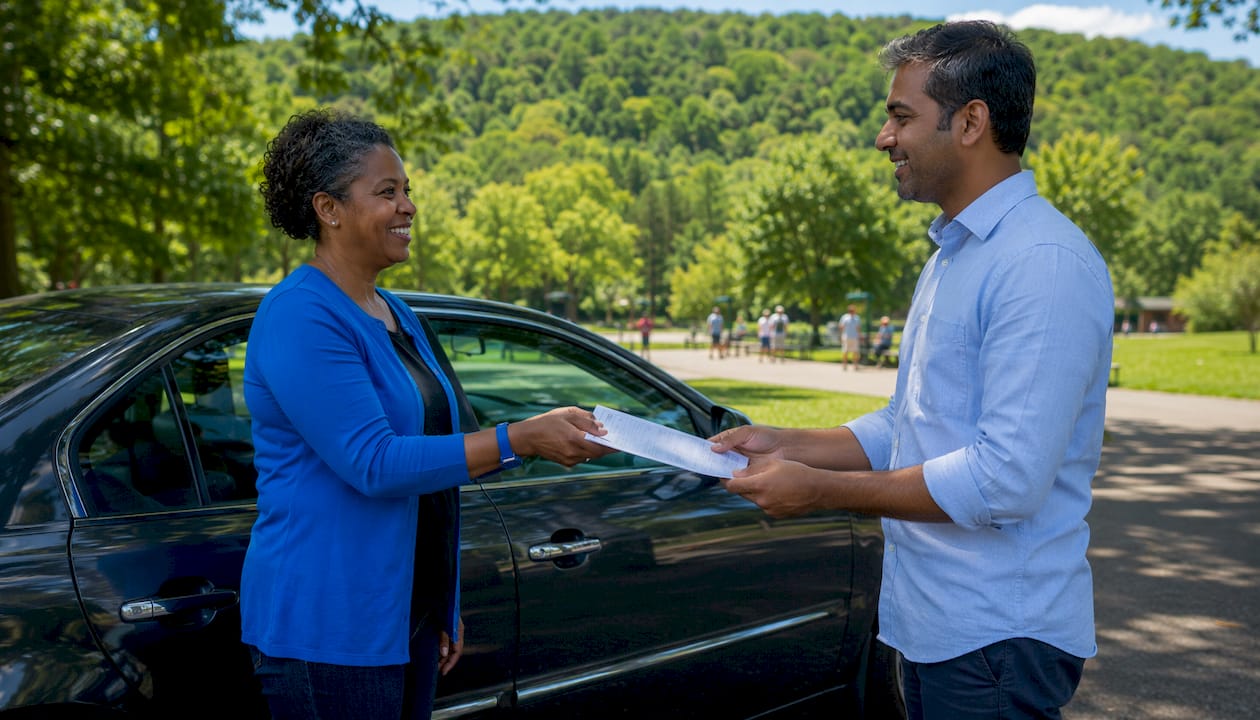
Selling your car privately follows a clear sequence: choose your selling method, gather your documents, prepare the vehicle, set a competitive price, advertise to the right buyers, screen inquiries, meet safely, and close the deal with verified payment and a legal title transfer. Skip a step or do them out of order and you risk delays, legal exposure, or getting less than your car is worth. Done right, private sales net 10–25% more than dealer trade-ins, though the process typically takes several days and requires some focused effort.
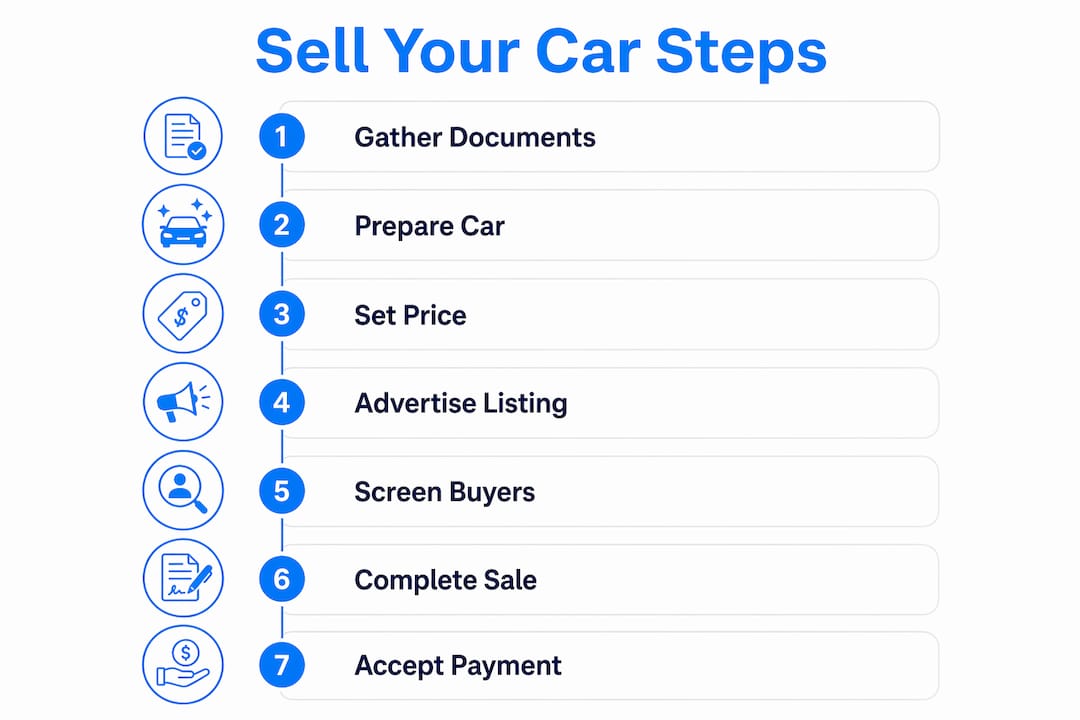
Here is the full car selling process step by step:
- Choose your selling method (private sale, trade-in, or instant cash offer)
- Gather your documents (title, registration, bill of sale, service records)
- Prepare the vehicle (clean, photograph, disclose known issues)
- Price competitively using Kelley Blue Book and local comparables
- Advertise on platforms like Facebook Marketplace and Craigslist
- Screen buyers and schedule safe showings
- Meet safely and verify buyer identity before any test drive
- Close the sale with signed title, bill of sale, and verified payment
- File a release of liability with your state DMV the same day
Safe payment means cash, a cashier’s check, or a verified bank transfer only. Never hand over the keys until funds are confirmed.
What are your options for selling a car?
Not every seller has the same priorities. Some want maximum cash. Others want the car gone by Friday. Your selling method shapes everything that follows, so pick the one that fits your situation before you do anything else.
Private sale gives you the highest return. You control the price, the timeline, and the negotiation. The trade-off is time: you will handle listings, buyer messages, test drives, and paperwork yourself. Expect the process to run 2–10 days from listing to handoff.
Instant cash offers from online platforms flip that equation. You enter your VIN, answer a few condition questions, and get an offer within minutes. Sales through these platforms can move from listing to payment in under an hour. You will likely leave some money on the table compared to a private sale, but for sellers who value speed over maximum price, it is a legitimate trade.
Dealer trade-in is the most convenient path. The dealer handles all paperwork, and in most U.S. states, trade-ins reduce your tax burden because sales tax applies only to the price difference between your trade-in value and the new vehicle you purchase. That tax savings can close the gap between trade-in and private sale proceeds, depending on your state.
Key considerations for each method:
- Private sale: highest price, most effort, 2–10 day timeline
- Instant cash offer: fast payout, minimal effort, slightly lower price
- Trade-in: convenient, tax benefit in most states, lowest gross proceeds
- Hybrid approach: get instant cash offers first to establish a price floor, then list privately if the offers fall short
For a side-by-side breakdown of how these paths compare on price and effort, car selling options compared covers the full picture.
What documents do you need to sell a car?
Paperwork problems are the most common reason private sales stall at the finish line. Pull these together before you photograph the car or write a single listing word.
- Certificate of title in your name. This is the non-negotiable document. If your title is lost, apply for a duplicate at your state DMV. Most states issue duplicates within 1–3 weeks.
- Lien release or payoff coordination. If a lender’s name appears in the lienholder field, you have a financed vehicle. Contact your lender for the exact payoff amount and instructions before listing.
- Current registration. Most states require valid registration before a title transfer can proceed.
- Bill of sale. This serves as the official receipt for the transaction. It is required in some states and strongly recommended in all of them. It should include the sale price, odometer reading, vehicle identification number (VIN), and both parties’ names and signatures.
- Maintenance and service records. Not legally required, but buyers pay more for documented history. A full service folder signals a well-cared-for vehicle.
- Vehicle history report. A CARFAX or AutoCheck report answers the questions buyers will ask anyway. Providing one upfront builds trust and reduces back-and-forth.
State requirements vary. California, Texas, and Illinois each have their own title transfer and release of liability forms. Check your state DMV website for the exact forms required. For a complete legal checklist, documents needed to sell a car walks through every state-specific requirement.
How should you prepare your car for sale?
Presentation directly affects your final sale price. A clean, well-photographed car attracts more inquiries, commands a higher asking price, and closes faster than one that looks neglected in photos.
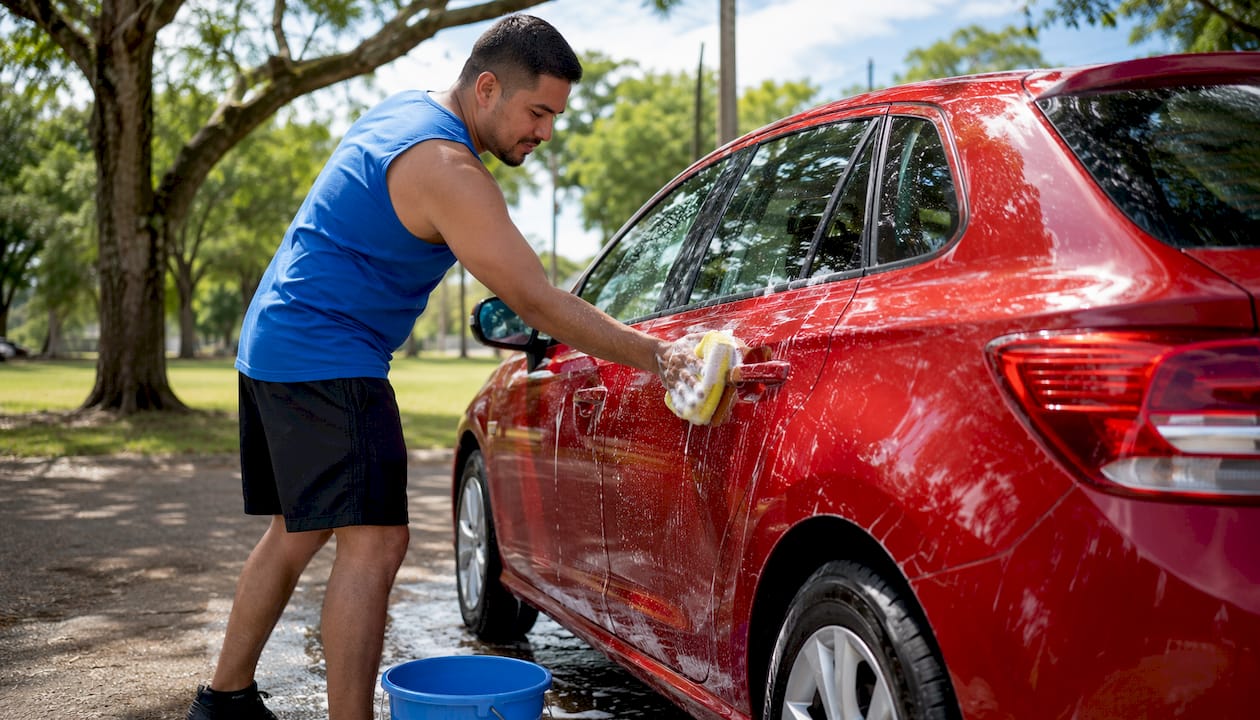
Professional detailing before listing can add $500 to $1,000 to your sale price, making it one of the highest-return investments in the entire process. At a minimum, do a thorough hand wash, clean the wheels and tires, vacuum the interior, wipe down the dashboard and door panels, and clean the windows inside and out.
Beyond cleaning:
- Fix minor cosmetic issues. Small dents under 3 inches, chipped paint, and broken trim pieces are inexpensive to address and disproportionately affect first impressions.
- Replace worn consumables. Wiper blades, a burnt-out bulb, or a dirty air filter cost very little but signal neglect if left unaddressed.
- Remove all personal items. Declutter the cabin, trunk, and glove box completely.
- Photograph thoroughly. Shoot in even daylight, ideally in the hour after sunrise or before sunset. Cover the front three-quarter, rear three-quarter, both sides straight-on, driver’s seat, dashboard with odometer visible, engine bay, and any existing damage. Ten to fifteen photos is the right range.
- Disclose known issues honestly. Most states require disclosure of known defects. Beyond the legal obligation, honest disclosure protects you from post-sale disputes.
Pro Tip: Blur your license plate in every photo before uploading. It takes thirty seconds and prevents your plate from being captured by anyone browsing listings.
How do you price your car competitively?
Price too high and your listing sits. Price too low and you leave real money behind. The right number comes from three data sources used together, not just one.
Start with Kelley Blue Book private-party value at kbb.com. Enter your year, make, model, trim, mileage, and condition to get a realistic private-sale range. This is your anchor. Then search Facebook Marketplace and Cars.com for the same year, make, model, and trim in your zip code to see what comparable vehicles are actually listed for locally. Local supply and demand can move your number up or down from the KBB baseline.
A few pricing principles that hold in 2026:
- Set your asking price slightly above your target. Negotiation margins have narrowed to roughly 3–5% of list price, so you do not need a large buffer. Adding 5–8% above your minimum gives you room to negotiate without pricing yourself out of the market.
- Add “OBO” (or best offer) to your listing. It signals flexibility and typically increases the volume of inquiries.
- Use instant cash offers as a floor. Get quotes from two or three online platforms before listing privately. If your private-sale offers do not beat those numbers, you know the market ceiling.
- Adjust for condition and extras. A full service history, new tires, or a recent brake job justifies a price above comparable listings with no documentation.
How do you advertise your car and screen buyers?
Your listing is your first impression. A weak headline and three blurry photos will produce low-quality inquiries. A clear, honest listing with good photos attracts buyers who are ready to move.
Facebook Marketplace and Craigslist cover the majority of U.S. private-party transactions. Facebook generates higher volume; Craigslist tends to attract more serious buyers. Start with both. Facebook is free; Craigslist charges $5 per listing in most categories.
Writing the listing:
- Lead the headline with the most compelling facts: mileage, ownership history, recent service, and asking price.
- In the body, cover ownership history, maintenance highlights, why you are selling, and your preferred payment method.
- Disclose all known issues. Buyers who discover undisclosed problems during a test drive walk away, and you lose the time you invested.
- Never include your full home address. Use a nearby landmark or ZIP code only.
Screening buyers:
Genuine buyers ask specific questions about maintenance history, accident records, and whether you are open to negotiation. Scammers and tire-kickers stop responding after “yes, still available.” Watch for these red flags:
- Offers to pay more than your asking price
- Requests to ship the car or use a third-party escrow service
- Buyers who refuse to speak by phone and communicate only by text
- Anyone asking you to send money back after overpaying
A simple screening reply works well: confirm availability, propose a specific meeting time, and share the address only after the buyer confirms. Vague inquiries drop off; serious buyers commit.
What safety steps should you follow when selling privately?
Meeting strangers to sell a car carries real risks. A few precautions protect both your personal safety and your money.
- Meet in a public, well-lit location. Police station “safe exchange zones” are now available in most U.S. metro areas and are specifically designed for private transactions. Use them.
- Meet during daylight hours.
- Bring a friend or family member. Two people present changes the dynamic significantly.
- Verify the buyer’s driver’s license before any test drive. Take a photo of it.
- Ride along on every test drive. Choose the route yourself. Never let a stranger take your car alone.
- Do not release the keys until payment is fully verified.
For transactions over $5,000, meet at a bank branch. Have the bank teller verify the cashier’s check before you sign anything. This step takes fifteen minutes and eliminates the most common payment fraud scenario.
Pro Tip: Tell someone you trust the buyer’s name, phone number, and meeting location before you leave. A quick text takes ten seconds and gives you a safety net.
For a deeper look at protecting yourself through the entire transaction, safe car sale transaction guide covers every stage from first contact to key handoff.
How do you complete the paperwork and DMV requirements?
The final paperwork is where sellers most often make mistakes that cost them later. Get this right and the sale is legally clean from day one.
- Sign the title correctly. Fill in the buyer’s full name and address, the odometer reading, the sale date, and your signature in the seller field. Any error on the title can delay the buyer’s registration and create liability for you.
- Complete a bill of sale. Both parties should keep a signed original. Include the VIN, sale price, odometer reading, and both parties’ names, addresses, and signatures. Some states require notarization for sales above a certain amount.
- Remove your license plates. Most states require the seller to keep the plates when the vehicle transfers. California is a notable exception where plates stay with the vehicle. Check your state’s rule before the handoff.
- File a release of liability with your DMV the same day. This is the step most sellers skip. Failing to file promptly keeps you legally responsible for any incidents involving the vehicle until the buyer completes registration. California gives sellers five days; Illinois requires the Report of Sale to be filed immediately. Check your state’s deadline.
- Notify your insurance provider. Call the same day the sale closes and have the vehicle removed from your policy. Do not cancel before the sale is final, in case anything goes wrong at the meetup and you need to drive the car home.
- Keep copies of everything. Store your signed bill of sale and a screenshot of the DMV filing for at least four years.
What are the safest ways to accept payment when selling a car?
Payment fraud is the most common way private car sales go wrong. The rules here are simple and non-negotiable.
Accept only cash, a cashier’s check, or a verified bank transfer when selling privately. Personal checks carry too much risk. A check can clear initially and then bounce days later, leaving you with no car and no money.
- Cash is the cleanest option for transactions under $2,500. Count it in person before signing anything.
- Cashier’s checks are reliable when verified. For cashier’s checks over $2,500, meet the buyer at the issuing bank and have a teller confirm the check’s authenticity before you sign the title.
- Verified bank transfers (wire transfers or Zelle for confirmed amounts) work well for higher-value transactions. Confirm the funds have posted to your account before handing over the keys or signing the title.
- Never accept overpayment. A buyer who sends more than the agreed price and asks you to return the difference is running a scam. The original check is counterfeit; you absorb the full loss.
- Do not sign the title until payment is in hand and verified. Once the title is signed over, your legal claim to the vehicle is gone.
Keep a written record of the payment method, amount, date, and the buyer’s identification. Pair that with your signed bill of sale and you have a complete transaction record.
Key Takeaways
Selling your car privately in 2026 delivers the best price when you follow each step in sequence, from documents and preparation through verified payment and same-day DMV filing.
| Point | Details |
|---|---|
| Private sale premium | Private sales typically net more than dealer trade-ins but require 2–10 days of active effort. |
| Detailing return | Professional detailing before listing can add $500 to $1,000 to your sale price. |
| Pricing buffer | Set your asking price slightly above your minimum; negotiation margins have narrowed to roughly 3 to 5 percent of listing price. |
| Safe payment only | Accept cash, cashier’s checks, or verified bank transfers; verify cashier’s checks over $2,500 at the issuing bank. |
| Release of liability | File with your state DMV promptly after the sale to end your legal responsibility for the vehicle. |
Want to skip the private sale process entirely?
If the steps above look like more time and effort than you want to spend, Sellkamocars offers a direct alternative. You get a fair cash offer based on current market data, free pickup, and payment within 24 hours. No strangers at your door, no negotiating, no paperwork headaches.
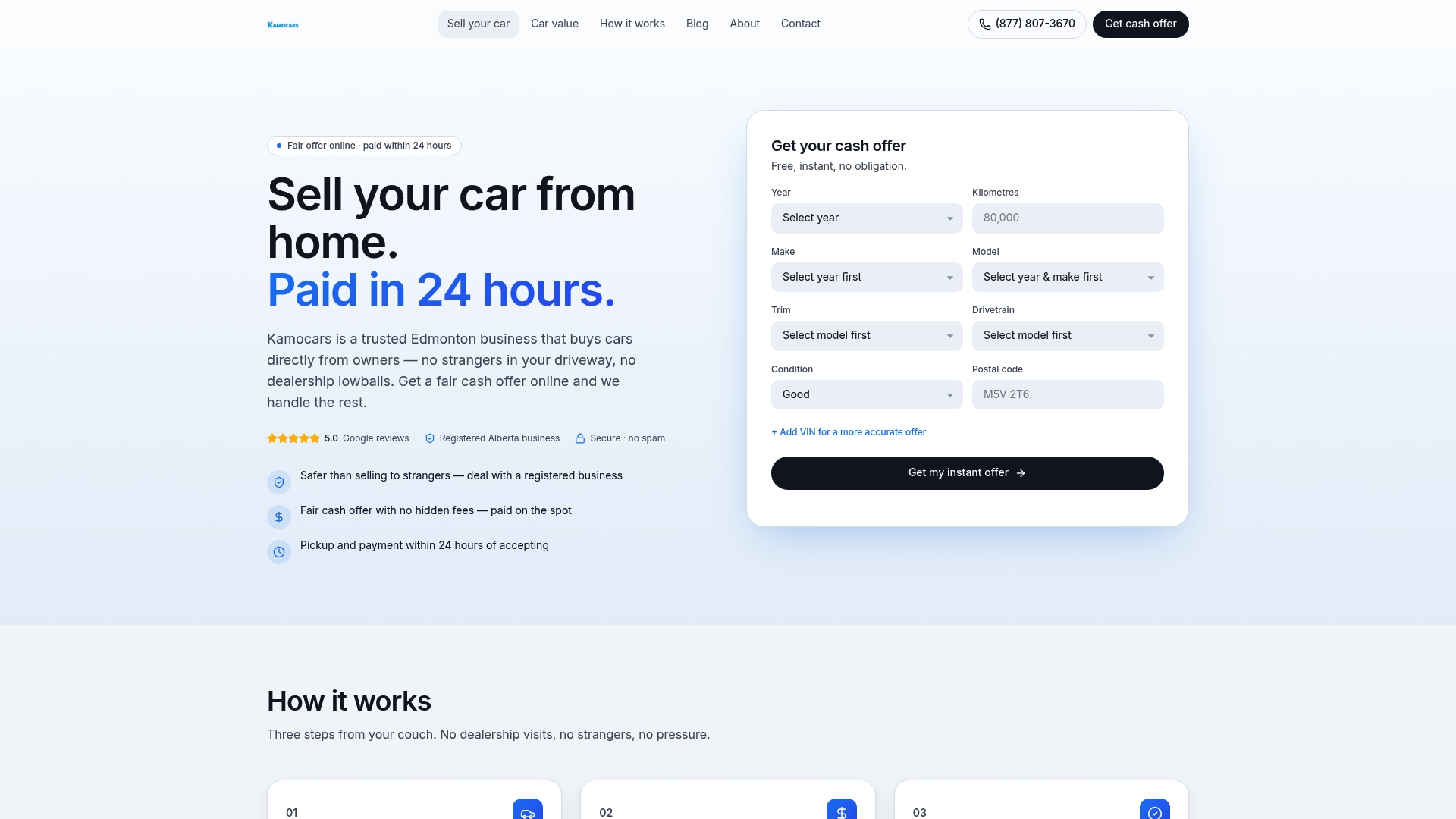
Sellkamocars has completed over 500 transactions with a strong customer rating, and its registered business status means you are dealing with a verified buyer, not an anonymous listing. See how it works or go straight to get your cash offer to find out what your vehicle is worth today.
Recommended
Get a real cash offer in 2 minutes
Trusted business. Fair price. Paid on the spot when we pick up your car.